Verification
Proof you can runon your machine
Period-close proofs, tamper-evident audit chains, and receivable attestations — verify independently in the browser, on Desktop, or from the terminal.
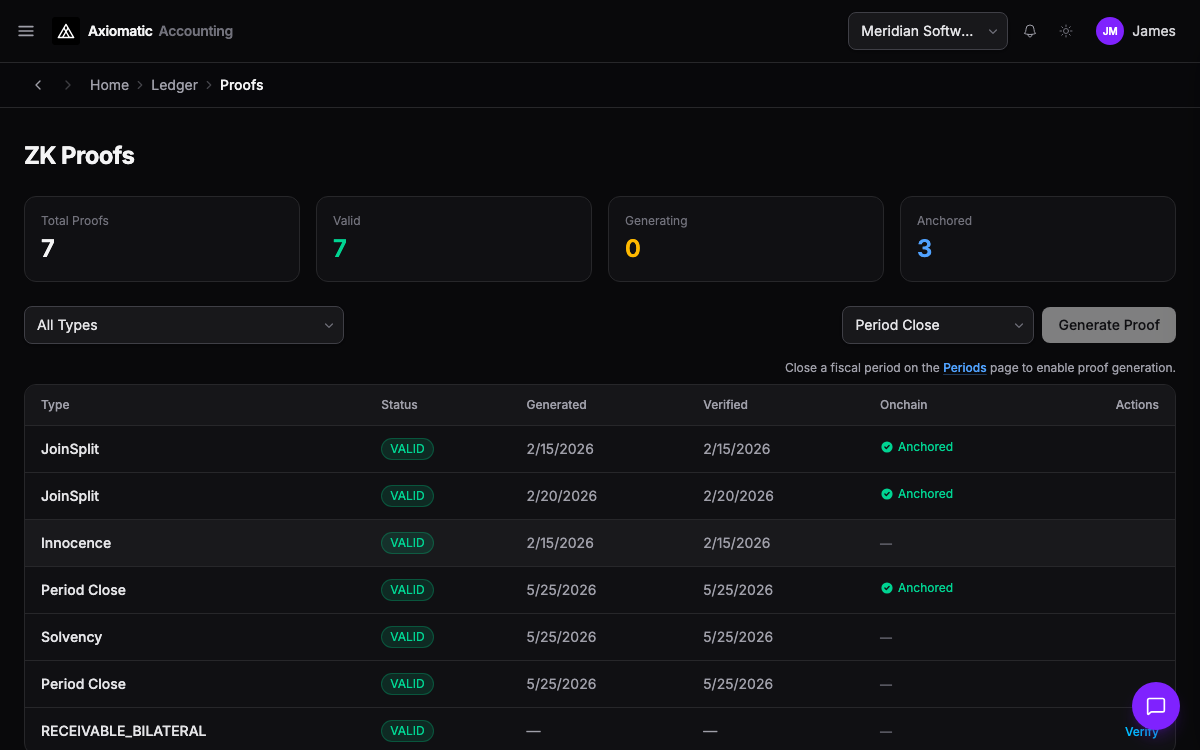
Period-close proof with anchor transaction and verification pipeline
What you can verify
Built into the ledger — exports and share links for anyone who needs to confirm the math without trusting a PDF.
Period-close proofs
Zero-knowledge proofs that your trial balance ties for a book and period — public inputs only, no line-item exposure.
Audit chain integrity
Hash-chained audit logs you can walk end to end. Recompute sequences locally and confirm nothing was altered.
Receivable attestations
Financeable AR exports with witness bundles financiers verify independently — the same packages Desktop and the CLI consume.
Three ways to verify
Start with a share link in the browser. Move to Desktop or the CLI when you need the full local check.
Verify workspace
Open a seller share link in the browser for attestation summary and package download — no login required for read-only checks.
Open Verify workspaceAxiomatic Desktop
Run the full cryptographic check on exported JSON on macOS or Windows. Pinned verification keys ship with the app.
Download DesktopOpen-source CLI
Script verification in CI, credit ops, or auditor workflows. Same engine as Desktop — axiomatic-receivable verify against exported packages.
See Desktop & CLIAxiomatic Desktop
Local proof verification on macOS and Windows. Open exported JSON, run the same checks as the Verify workspace, and keep sensitive packages on your machine.
macOS 13+ (Apple Silicon and Intel) and Windows 10+. Touch ID sign-in on signed Mac builds.
Full Desktop & iOS details →$ axiomatic-receivable verify ./exports/proof.json
circuit·receivable-attestation
vk·pinned · open source
bundle_hash·matched
status·VALID
Proof verified locally
Same verifier engine bundled in Axiomatic Desktop — scriptable for CI, credit ops, and auditor workflows.
Encryption and isolation
Verification proves the numbers tie. Per-tenant databases, encryption at rest, and tamper-evident logging protect how those numbers are stored.